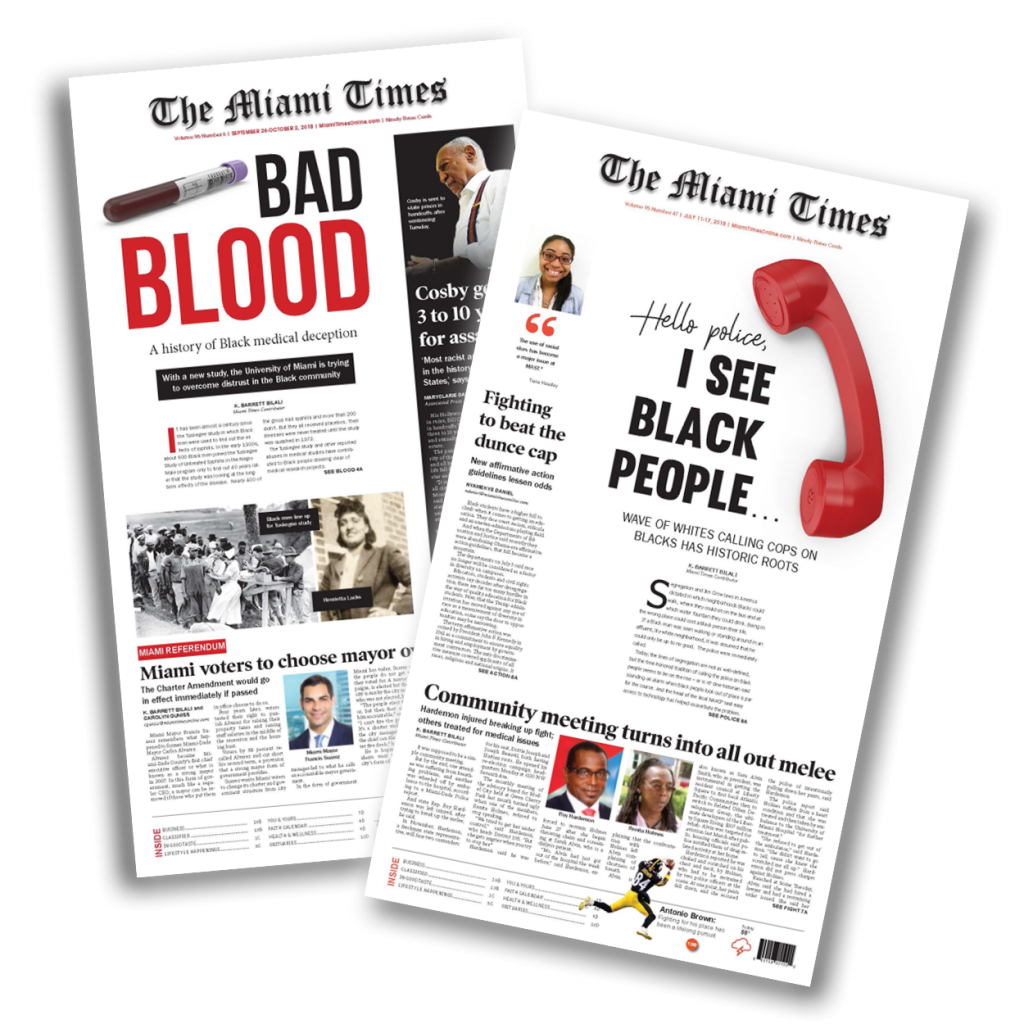
Unlike many other major metropolitan areas, South Florida’s Black community is dispersed across numerous neighborhoods rather than concentrated in just one or two. This widespread distribution presents a challenge for organizations trying to target the community effectively. That’s why The Miami Times is a valuable resource. We take pride in our extensive distribution network, striving to make our newspaper readily accessible. Copies are available at many popular retailers listed below, along with numerous neighborhood stores, churches, and local businesses.
Download List
Download Map
Miami, Miami Gardens, Miami Lakes, Miami Springs, North Miami, Coconut Grove, Fort Lauderdale, Hialeah, Hollywood, Homestead, Marathon, Miramar, Opa-locka, Pembroke Pines, Plantation, Perrine, Richmond Heights, South Miami, and West Miami.
33009 33010 33012 33013 33014 33015 33016 33018 33020 33021 33023 33024 33025 33026 33030 33031 33032 33033 33034 33050 33054 33055 33056 33125 33126 33127 33128 33130 33132 33133 33134 33135 33136 33137 33138 33139 33140 33141 33141 33142 33143 33144 33145 33146 33147 33149 33150 33153 33154 33155 33156 33157 33159 33160 33161 33162 33163 33165 33166 33167 33168 33169 33170 33172 33173 33174 33175 33176 33177 33179 33180 33181 33182 33183 33184 33185 33186 33189 33193 33196 33247 33302 33309 33311 33312 33313 33314 33317
We take pride in our wide distribution network throughout South Florida. Our goal is to make sure readers can conveniently find a copy of The Miami Times at popular retail outlets, neighborhood markets, churches, and local businesses.
All over South Florida, there is evidence of population and business growth. Many Black-owned businesses are dotting the landscape to service the new residents. The Miami Times continues to offer people a way to find out more about where to live, where to educate their children and how to connect.
Some of our neighborhoods are very distinct. Here are some highlights.
The largest Black community in the state can be found in Miami Gardens. No more evident are the signs of growth than here. Several national chains and small businesses have made Miami Gardens home. They join a renovated Hard Rock Stadium as well as Florida Memorial University, South Florida’s only historically Black college. Jazz in the Gardens, Miami Gardens signature estival, continues to draw upwards of 65,000 people annually.
Nearby Opa-locka is home to an Amazon fulfillment center as well as an executive airport. The city is home to the largest collection of Moorish architecture in the country. North Miami has a large enclave of upwardly mobile Haitian Americans, who are also politically empowered. The Biscayne Bay Campus of Florida International University calls North Miami home. The university sits on 200 acres and services about 7,000 students.
In the center of the county, the communities of Overtown, Liberty City, Brownsville, Allapattah, Little Haiti, West Little River, Coconut Grove and downtown Miami are all undergoing explosive growth. WorldCenter Miami, the second-largest urban development in the country, is expected to be completed by 2021. The $2 billion mixed retail-housing-entertainment project, sits on the edge of Overtown on 27 acres. The re-development of Liberty Square will bring a mixed-income, mixed-use community that is a result of a public-private partnerships, a business model favored by the U.S. Department of Housing and Urban Development.
In the southernmost part of Miami-Dade, sits historic Richmond Heights, Goulds, Florida City and Homestead, solid neighborhoods with generational families. In Broward County, cities such as Miramar, Hollywood, Plantation and Fort Lauderdale, have Black families who engage in cultural activities, such as visiting the Miramar Cultural Center or attending lectures at the African-American Research Library and Cultural Center.
As Florida’s oldest and largest Black newspaper, we are the premier medium for reaching South Florida’s Black Community. The Miami Times is a trusted name that continues to deliver results for both readers and advertisers.